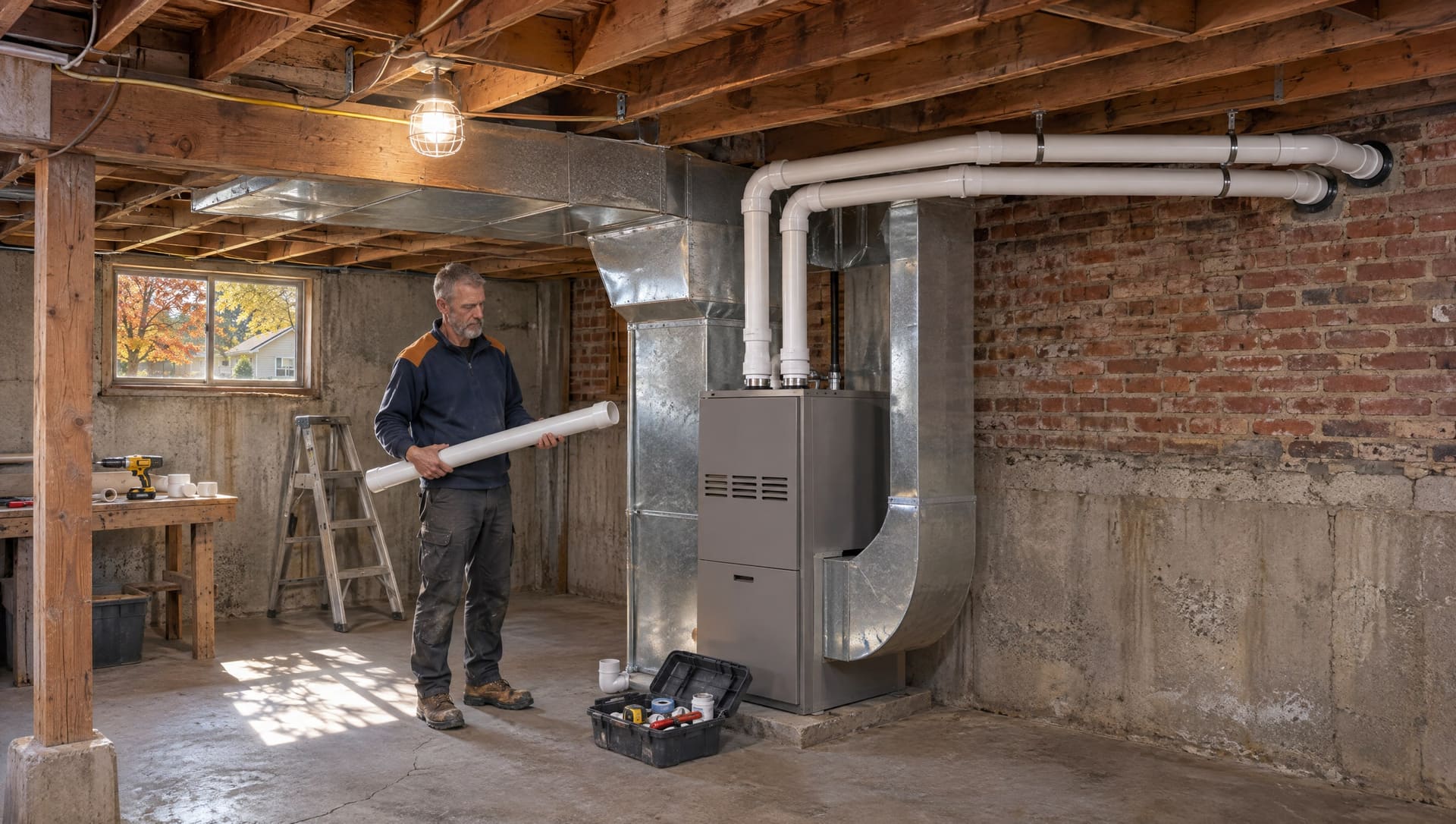
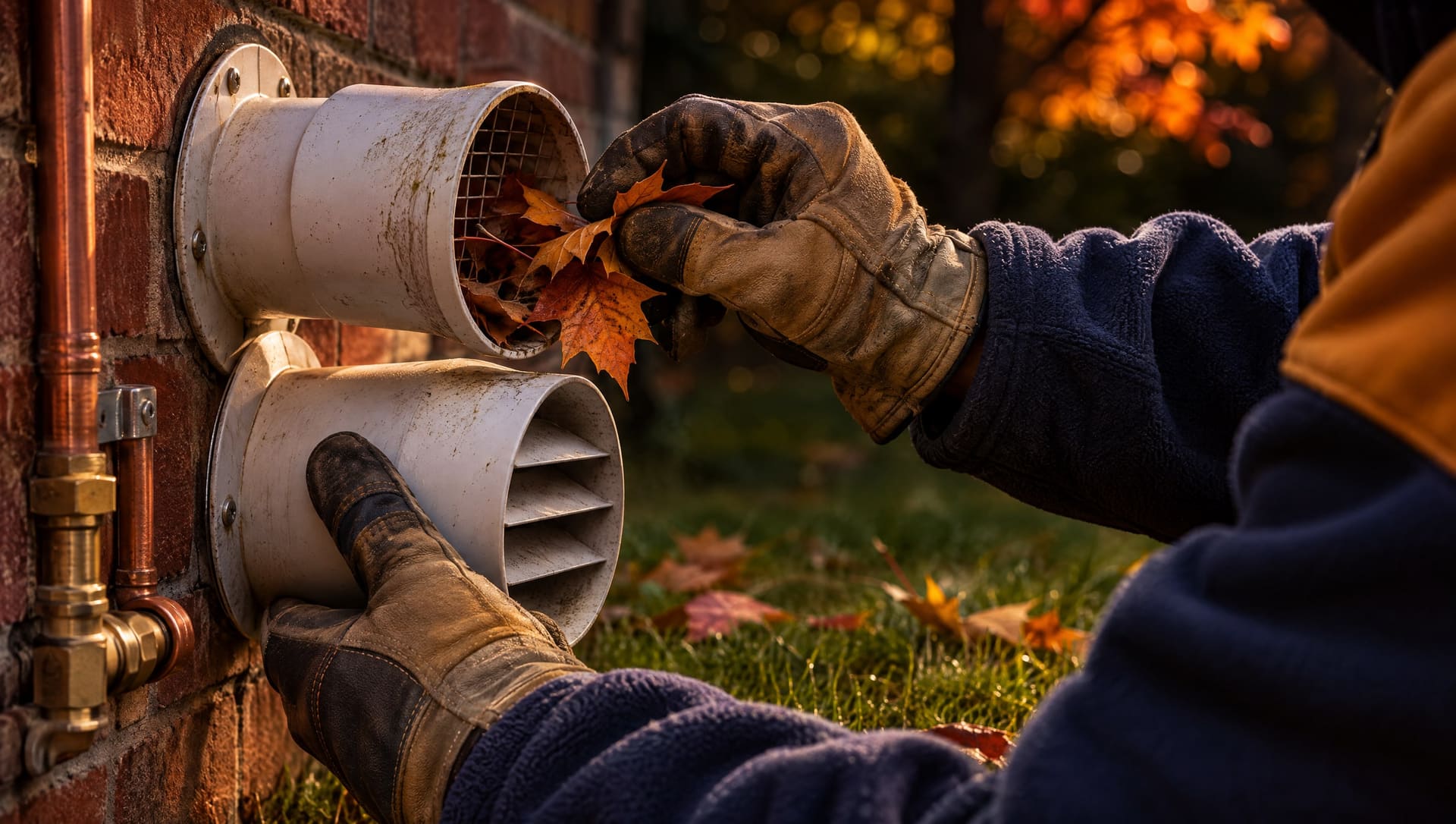
If your house in Angus, Thornton or Baxter went up from the 1990s onward, the furnace in the basement is almost certainly a high-efficiency condensing model. It doesn't use a chimney. Instead, two plastic pipes come out through the side wall of the house, often low and close to the ground, sometimes behind a hedge or beside the deck stairs. Most of the year you won't think about them. Then a storm blows through, a drift builds against that wall, and the furnace stops.
Below is why that happens, what short cycling usually means, and what you can safely check yourself before you call anyone.
Essa winters are hard on low side-wall pipes
Environment Canada's 1991 to 2020 climate normals for Egbert, the nearest reporting station, show about 174.1 cm of snow a year, falling on roughly 57 days. The average January daily low is −11.3 °C, and the record low is −35.5 °C, set on January 16, 1994. The heating season adds up to about 4,278.8 degree days below 18 °C. In practice, the furnace runs from fall well into spring, and for much of that time there is snow piled against the house.
Wind matters as much as snowfall. A wall facing open fields can drift in overnight even after a light snowfall, and snow sliding off the roof or thrown by the plow can bury pipes that looked fine at supper time.
Why the side-wall pipes matter
A condensing furnace takes the heat out of its exhaust so thoroughly that the gases come out cool enough to travel through plastic pipe. That's why it can vent out the side wall instead of up a chimney. The two pipes each do a separate job:
- The intake pipe brings outdoor air in for combustion.
- The exhaust pipe carries the flue gases out, along with a white plume of water vapour you'll see on cold days.
The furnace checks that both are clear before it lights and keeps checking while it runs. A small fan called the inducer pulls air through the system, and a pressure switch confirms the air is moving properly. If snow blocks the intake or the exhaust, the pressure switch sees the change and the furnace shuts itself off. That's deliberate: a furnace that can't exhaust properly shouldn't be burning gas.
Snow isn't the only cause. In a long cold snap, the moisture in the exhaust can freeze at the pipe's end and slowly close it off. Frost can also form on the intake screen. Either way, the furnace may light, run for a minute or two, shut down, wait and try again.
Why your furnace keeps turning on and off
Short cycling means the furnace starts and stops much more often than it should, or never runs long enough to warm the house. In an Essa winter, the usual causes, roughly from most common to least, are:
- A partly blocked vent. It's clear enough to start but not enough to keep running. Snow, frost or ice at the pipe ends is the first thing to check after a storm or a cold spell.
- A clogged filter. The furnace overheats, a safety switch turns the burners off, and they come back on once it cools. The upstairs bedroom that never warms up often gets worse when this happens.
- A condensate problem. A condensing furnace makes water, which drains through a trap and a hose to a floor drain or a small pump. If the trap is plugged, the hose has kinked, or a line through a cold space has frozen, water backs up and the pressure switch trips the furnace.
- A dirty flame sensor. The burners light and then shut off within seconds because the furnace can't confirm a flame.
- A thermostat issue. Weak batteries, or a thermostat mounted near a heat register, a sunny window or a drafty door.
- A furnace too big for the house. It heats the area around the thermostat quickly and shuts off before the rest of the house catches up. A technician can tell you whether this is the case; adjusting settings won't fix it.
The first three are the ones you can look at yourself.
What to check before calling for a furnace repair
These checks are safe for a homeowner and often get the heat back on.
- Check the thermostat. Make sure it's set to heat and the set point is above room temperature. If it takes batteries, replace them.
- Check the furnace switch. It looks like a light switch on or near the furnace, sometimes at the top of the basement stairs, and it's easy to flip off by accident.
- Check the filter. Hold it up to a light. If you can barely see through it, replace it.
- Go outside and look at the two pipes. Clear the snow away by hand or with a broom, leaving a good margin around them. Gently break off any frost or ice at the pipe ends. Don't use a shovel blade near the pipes, as plastic pipe cracks in the cold.
- Check the condensate. Look for water around the base of the furnace, a hose that has slipped out of the drain, or a condensate pump that has stopped running.
- Reset the furnace once. After the vents are clear, turn the furnace switch off, wait a minute and turn it back on. Many furnaces lock out after several failed starts, and this clears the lockout.
If it still won't run, or it runs and shuts off again, stop there. Resetting it over and over won't fix the cause, and some faults aren't ones to keep testing.
When to stop and call
Call for service if the vents keep blocking up, if you smell gas, if the furnace keeps locking out after the vents are clear, or if your carbon monoxide alarm sounds. If the alarm goes off or you smell gas, get everyone out of the house first and call from outside.
The Ontario Fire Code requires a working carbon monoxide alarm next to each sleeping area in any home with a fuel-burning appliance, a fireplace or an attached garage. Most Essa homes have at least one of those. A storm that blocks the furnace vents is a good time to press the test button.
Your gas in Essa comes from Enbridge, but Enbridge says it doesn't sell or repair furnaces and directs customers to an HVAC contractor. A furnace that won't run is a contractor call, not a call to the gas company, unless you smell gas.
Fixing a vent that keeps getting buried
If your pipes end up in a drift every winter, clearing them by hand after each storm is a chore, and if you're away it may not get done. The pipes can be extended higher on the wall, moved to a wall that doesn't drift, or fitted with a different termination. Any change has to follow the installation code for spacing from windows, doors, the gas meter and the ground. That work involves gas venting, so in Ontario it falls to a registered gas contractor. Work is performed by TSSA-certified gas technicians.
In the meantime, a few habits help:
- Keep snow from the driveway, the roof and the plow off that wall.
- Don't stack firewood, bins or the barbecue cover in front of the pipes.
- Look at the pipes after every storm and during any long stretch of extreme cold.
- Change the filter on schedule, more often in the deep part of winter.
A seasonal tune-up is also a good time to have the condensate trap cleaned and the vent terminations inspected before the snow comes. See furnace and AC maintenance. If you're not sure what kind of system you have, what kind of furnace is in your Essa house explains the main types.
If the vents are clear and the furnace still won't stay on, see furnace repair. You'll get a written price before any part goes in.